People, Process, Technology and Data for Sustainable Transformation

*Updated 26 March 2025*
Digital transformation rarely fails because an organisation lacks technology.
Problems appear when technology changes but the process does not, employees are not brought with it or the data needed to understand performance remains disconnected.
That is why the traditional People, Process and Technology model still matters, but it is no longer complete.
Data now needs to sit alongside all three.
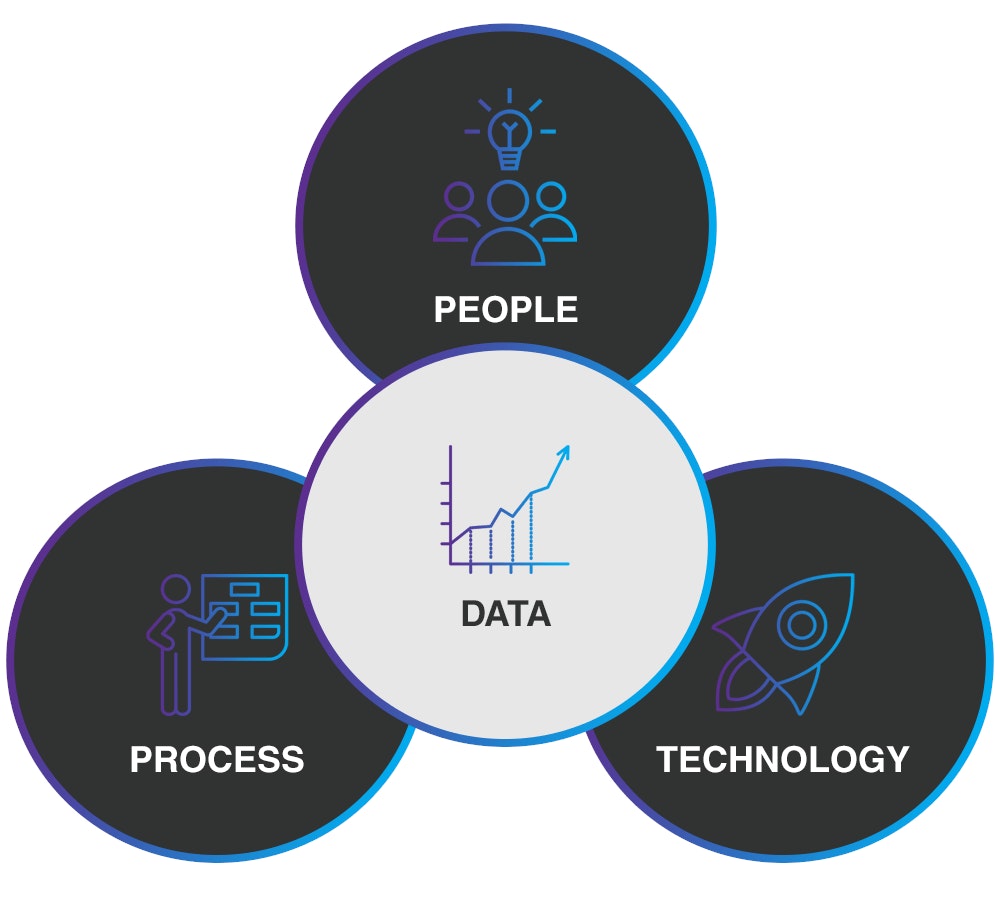
Together, People, Process, Technology and Data, or PPTD, provide a practical way to assess whether transformation is genuinely connected across the organisation.
This is becoming particularly important as AI adoption accelerates. The UK Business Data Survey 2026, published on 18 June 2026, found that 41% of businesses handling digitised data were using AI for at least one purpose. Yet only 21% of AI-using businesses had integrated those tools into existing business systems.
That gap demonstrates why transformation cannot be led by technology alone.
People
People remain fundamental to successful transformation.
Technology can automate more work, provide better information and help employees operate faster, but people still determine how effectively those capabilities are used.
Microsoft's 2026 Work Trend Index, published on 5 May 2026, found that 66% of surveyed AI users said AI allowed them to spend more time on higher-value work. The research also emphasised that organisational factors have a major influence on whether AI creates meaningful value.
For businesses, that means transformation needs to consider more than training employees to use a new platform.
Employees need to understand why something is changing, how it improves their work and where their judgement is still required.
The strongest organisations also involve employees early enough for their operational experience to shape the solution.
Britannic's work with Trailfinders follows this principle, using workshops and operational insight to understand challenges before determining where technology, AI or process change could add the greatest value.
Process
Process defines how work actually moves through the organisation.
This is where transformation can either remove friction or simply digitise it.
A process may include approvals, emails, handovers, customer interactions, system updates and decisions made across several teams.
Adding technology to an inefficient workflow does not automatically make that workflow effective.
Organisations should first understand where work slows down, where employees repeat tasks, where customers have to make unnecessary contact and where information becomes disconnected.
The opportunity is then to simplify the process before deciding what should be automated, integrated or supported by AI.
Britannic's Digital Transformation approach reflects this by examining existing workflows, operational friction and business objectives before determining where technology should change.
Technology
Technology should enable the process rather than dictate it.
That increasingly means looking beyond individual products.
Enterprise communications, contact centres, Microsoft Teams, CRM platforms, AI, workflow technology and business applications all need to exchange information effectively if they are going to support a connected experience.
The question is therefore not simply:
Which technology should the organisation buy?
It is:
What does the organisation need its technology environment to enable?
That may involve improving existing platforms, introducing automation, integrating communications with business applications or replacing systems that are actively limiting progress.
Britannic's current positioning as a systems integrator is particularly relevant here. The objective is to connect technology around business outcomes rather than create another collection of disconnected platforms.
Data
Data is what allows the other three areas to improve.
People create it. Processes generate it. Technology captures it.
The challenge is turning that information into something useful.
The UK Business Data Survey 2026 found that 86% of UK businesses handled digitised data, yet the sophistication with which that data was used varied considerably. Large businesses were much more likely to analyse information to generate new insights.
Data can help organisations understand:
Where processes are failing, how employees are working, why customers make contact, whether technology is delivering value and where the next improvement should be made.
AI makes it increasingly possible to analyse information that previously remained difficult to use, including calls, emails, chats and other unstructured customer interactions.
The important step is ensuring that insight does not stop at a dashboard.
Britannic's AI Engine and wider digital transformation capabilities are designed to connect insight with workflows, CRM systems and operational processes so information can contribute to the next action. Explore Britannic's Digital Transformation solutions
Why Does PPTD Matter?
PPTD is most useful when the four elements are considered as one operating system rather than separate workstreams.
People understand the work.
Processes determine how it moves.
Technology enables it.
Data shows whether it is working.
A weakness in one area affects the others.
An organisation can implement excellent technology and still struggle if employees cannot use it effectively. Automation can accelerate a poorly designed process. High-quality data has little value if it never reaches the people or workflows capable of acting on it.
Sustainable transformation comes from alignment between all four.
The Britannic PPTD Alignment Check
Before starting the next transformation initiative, organisations should ask:
- People Have the employees and customers affected by the change helped identify the problem?
- Process Has the existing workflow been examined before technology is introduced?
- Technology Will the solution integrate with the wider environment rather than create another silo?
- Data What information will show whether the change is working?
- Outcome What measurable improvement should the organisation expect?
- Ownership Who will continue improving the solution after implementation?
If one of those questions cannot be answered, there may still be a gap in the transformation strategy.
Transformation Works When Everything Moves Together
PPTD is not about giving equal budget or attention to four separate areas.
It is about recognising that they are interdependent.
AI makes that relationship even more important.
Technology can increasingly perform work independently, but it still depends on good data, well-designed processes and people who define the objective, manage exceptions and assess the outcome.
Britannic helps organisations connect people, processes, data and technology through strategic consultancy, systems integration, AI, automation and its Customer Success Programme. The focus is on practical change that can be measured and continuously improved rather than transformation ending when the technology goes live.
Organisations reviewing a transformation programme can book a complimentary meeting with Britannic to identify where people, processes, technology or data may be limiting the value being achieved.
