How To Reduce The Risk Of Your Calls Being Labelled Spam

For many organisations, outbound calling is still a critical channel for sales, service and customer engagement, but its effectiveness has changed significantly.
We regularly speak to businesses who are seeing declining answer rates, even when their data, timing and teams haven’t changed. The assumption is often that customers are less responsive or that internal processes need adjusting.
In reality, something more fundamental is happening.
Calls are increasingly being filtered, labelled or ignored before a customer even has the chance to respond. Understanding why this happens and what can be done about it, is now essential for any business that relies on voice.
Quick Links
- Why Are My Business Calls Being Labelled As Spam?
- Why Are Customers Not Answering Our Calls Anymore?
- How Often Are Business Calls Incorrectly Flagged As Spam?
- What Triggers A Phone Number To Be Marked As Spam?
- Does Call Frequency Affect Spam Labelling?
- Are Outbound Sales Calls More Likely To Be Flagged?
- How Can I Stop My Business Calls From Being Marked As Spam?
- How Do I Verify My Business Phone Number?
- What Is Call Authentication And How Does It Work?
- Are Branded Calls Compliant With GDPR And UK Regulations?
- Can Analytics Help Identify Spam Call Issues?
- How Do Telecom Providers Decide Which Calls To Block?
- How Much Revenue Is Lost Due To Unanswered Calls?
- Do Spam Labels Affect Customer Trust?
- How Do Branded Calls Reduce Spam Labelling?
- Can I Display My Company Name On Outbound Calls?
- What Tools Improve Answer Rates For Outbound Calls?
- How Does Spam Labelling Impact Contact Centres?
- Is It Worth Investing In Branded Calling Solutions?
- How Is AI Changing Call Screening And Filtering?
- What Is The Future Of Outbound Voice Communication?
- Are Branded Calls Becoming The New Standard?
- How Britannic Helps - Branded Calls That Get Answered
Why Are My Business Calls Being Labelled As Spam?
Spam labelling is driven by a combination of telecom providers, device manufacturers and third-party data platforms working together to reduce unwanted calls.
These systems analyse patterns such as:
- Call volumes and frequency
- Answer and rejection rates
- Call duration
- Customer feedback, including blocks or spam reports
If a number starts to resemble known spam behaviour, it can be flagged.
The challenge for businesses is that many legitimate outbound strategies share these same characteristics. High-volume campaigns, follow-ups and low initial answer rates can all contribute to a number being classified as higher risk, even when the intent is entirely valid.
Why Are Customers Not Answering Our Calls Anymore?
Customer behaviour has changed in response to the rise in spam and nuisance calls.
According to Ofcom, millions of UK consumers receive suspicious or scam calls each month. As a result, people have become more cautious about answering unknown numbers.
In practice, this means:
- Unknown numbers are often ignored
- Spam-labelled calls are actively avoided
- Trust is required before engagement
Even when a call is legitimate, a lack of recognition is often enough to prevent it being answered.
How Often Are Business Calls Incorrectly Flagged As Spam?
There is no single global figure, but the scale of the issue is widely recognised.
Research from Hiya shows that spam detection systems are becoming more aggressive, with increasing numbers of calls being flagged or blocked based on behavioural patterns rather than confirmed malicious intent.
At the same time, the volume of unwanted calls continues to grow. Data from Truecaller estimates that tens of billions of spam calls are made globally each year, creating an environment where legitimate businesses are competing for attention against a high level of noise.
In this context, misclassification is not unusual. It is a by-product of systems designed to prioritise caution.
What Triggers A Phone Number To Be Marked As Spam?
Spam labelling is based on a mix of behavioural and reputational signals.
Some of the most common triggers include:
- High volumes of outbound calls within short periods
- Low engagement or answer rates
- Repeated calls to the same numbers
- Customer complaints or spam reports
- Use of numbers with an existing negative history
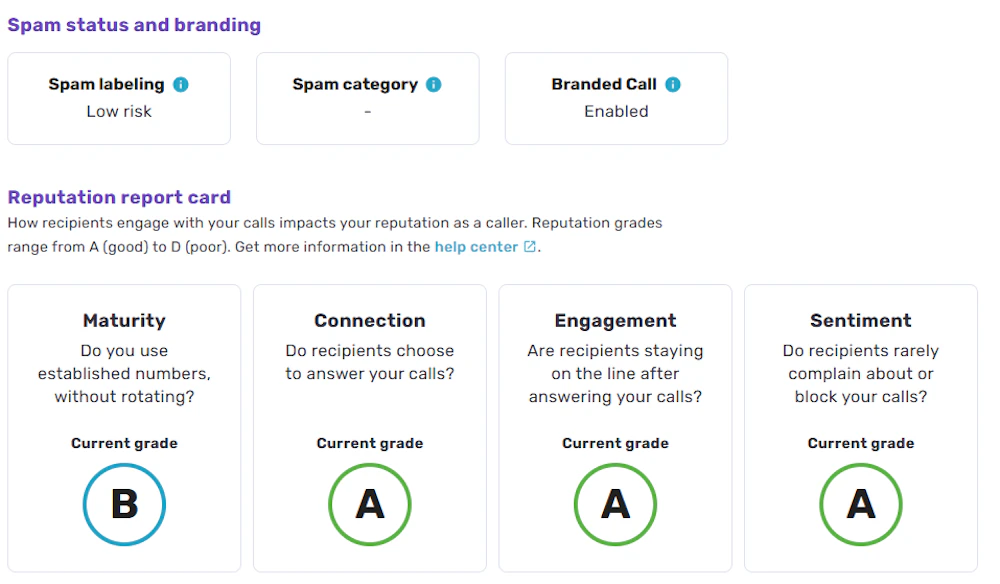
Over time, these factors contribute to a reputation score associated with your number. If that score declines, the likelihood of your calls being flagged or filtered increases.
Does Call Frequency Affect Spam Labelling?
Yes, particularly when combined with low recognition.
Frequent calls to the same number can be interpreted as intrusive, especially if the recipient does not recognise the caller. From a system perspective, repeated attempts without engagement can signal unwanted activity.
This can create a difficult cycle. As answer rates fall, businesses often increase call attempts to compensate, which can further reinforce the behaviour that triggers spam detection.
Are Outbound Sales Calls More Likely To Be Flagged?
Outbound sales activity is more likely to be affected because it often involves patterns that align with spam detection criteria.
These typically include:
- High call volumes
- Cold or unengaged contacts
- Lower answer rates compared to inbound interactions
Without clear identification, there is little to distinguish a legitimate sales call from an unwanted one, particularly at scale.
How Can I Stop My Business Calls From Being Marked As Spam?
Improving deliverability and answer rates requires a combination of changes rather than a single fix.
In practice, this means focusing on three areas:
- Establishing identity so customers can recognise who is calling
- Refining call strategies to avoid excessive or repetitive patterns
- Verifying numbers within telecom and identity ecosystems
While all three are important, identity is often the most immediate and impactful change.
How Do I Verify My Business Phone Number?
Verification involves linking your phone numbers to a recognised business identity.
This can include:
- Registration with telecom providers
- Validation through identity platforms
- Association with trusted business directories
Once verified, your number is more likely to be recognised as legitimate, both by filtering systems and by customers.
What Is Call Authentication And How Does It Work?
Call authentication is designed to confirm that a call originates from the number it claims to represent.
Globally, frameworks such as STIR/SHAKEN have been introduced to reduce spoofing and fraudulent activity. While the implementation varies across regions, the principle is consistent.
Calls that can be authenticated carry stronger trust signals and are less likely to be filtered or flagged.
Are Branded Calls Compliant With GDPR And UK Regulations?
When implemented correctly, branded calling solutions are fully compliant with GDPR and UK regulations.
They focus on presenting business identity rather than personal data, ensuring transparency without compromising privacy.
For organisations in regulated sectors, this added clarity can support both compliance requirements and customer confidence.
Can Analytics Help Identify Spam Call Issues?
Analytics plays an important role in understanding and improving outbound performance.
Without visibility, it can be difficult to determine whether declining answer rates are due to timing, data quality or spam filtering.
With the right tools, such as NetX, businesses can:
- Monitor answer rates across campaigns and numbers
- Identify patterns linked to poor performance
- Track changes over time
This allows for more targeted improvements and better decision-making.
How Do Telecom Providers Decide Which Calls To Block?
Telecom providers use increasingly advanced models to assess the risk associated with each call.
These models take into account:
- Historical behaviour of the number
- Patterns across the wider network
- Customer feedback and reporting
- Call frequency and engagement levels
If a number exceeds certain risk thresholds, calls may be labelled, silenced, or blocked entirely.
How Much Revenue Is Lost Due To Unanswered Calls?
The financial impact of missed calls is significant.
Research from Invoca highlights that missed calls directly affect revenue, particularly in high-intent channels such as voice.
Alongside this, real-world performance data shows the scale of improvement when caller identity is introduced:
- Sales teams have seen answer rates increase by over 50%
- Application follow-ups have improved by as much as 70%
- Service and appointment engagement has increased by nearly 60%
While results vary, the pattern is consistent. When customers recognise who is calling, they are far more likely to engage.
Do Spam Labels Affect Customer Trust?
Yes, and the impact is immediate.
Labels such as “Spam Risk” or “Scam Likely” create doubt before a conversation even begins. Even if the call is legitimate, the perception has already been influenced.
Trust is difficult to recover once lost, which makes prevention particularly important.
How Do Branded Calls Reduce Spam Labelling?
Branded calls address one of the core issues - lack of recognition.
By displaying your business name on outbound calls, they provide immediate context to the recipient. This helps customers understand who is calling and why.
Over time, improved answer rates and reduced negative feedback can also support a stronger overall reputation for your numbers.
Can I Display My Company Name On Outbound Calls?
Yes, but it requires the right technology.
Traditional telephony systems offer limited and inconsistent support for this. Branded calling solutions provide a more reliable way to present your business identity across supported devices.
This allows your calls to appear as recognised and legitimate, rather than unknown.
What Tools Improve Answer Rates For Outbound Calls?
Improving answer rates typically involves a combination of capabilities rather than a single solution.
These include:
- Caller identity through branded calling
- Analytics platforms to monitor performance
- More targeted and considered calling strategies
When used together, these approaches can significantly improve engagement.
How Does Spam Labelling Impact Contact Centres?
For contact centres, spam labelling can reduce efficiency across the board.
Common impacts include:
- Lower agent productivity
- Increased repeat call attempts
- Higher cost per contact
- Missed service targets
Improving answer rates can have a direct and measurable effect on overall performance.
Is It Worth Investing In Branded Calling Solutions?
For organisations that rely on outbound communication, the case is increasingly clear.
One of the biggest challenges businesses face today is not just low answer rates, but the growing risk of calls being ignored, flagged or perceived as untrustworthy. Without clear identification, even legitimate calls can be treated with the same caution as spam.
Branded calling directly addresses this issue by making it clear who is calling before the customer answers. This reduces the likelihood of calls being mistaken for spam and helps position your organisation as a recognised, legitimate business.
In practical terms, this leads to:
- More calls being answered rather than ignored
- Greater customer trust at the point of contact
- Fewer repeat call attempts and less wasted effort
As answer rates improve, the benefits extend beyond communication into revenue, customer experience, and operational efficiency.
Rather than adding a new capability, it restores the effectiveness of an existing channel.
How Is AI Changing Call Screening And Filtering?
AI is making spam detection more accurate and more adaptive.
Modern systems can:
- Learn from new patterns in real time
- Share intelligence across networks
- Continuously refine detection criteria
As a result, businesses need to place greater emphasis on trust and transparency to ensure their calls are delivered and answered.
What Is The Future Of Outbound Voice Communication?
Outbound voice is becoming more dependent on identity and trust.
Customers increasingly expect to know who is calling before they answer. Technologies that support verified identity and clearer communication will play a larger role.
Organisations that adapt to this shift are more likely to maintain engagement levels.
Are Branded Calls Becoming The New Standard?
There is a clear shift in this direction.
As spam filtering becomes more advanced, anonymous calls are becoming less effective. Branded and verified calls offer a way to stand out and maintain trust.
In sectors where outbound communication is critical, this is quickly moving from a differentiator to an expectation.
Declining answer rates are often treated as an operational challenge. In many cases, they are better understood as a trust and visibility issue.
If customers do not recognise your call, they are unlikely to answer it. Addressing that gap is key to improving performance.
How Britannic Helps - Branded Calls That Get Answered
Britannic work with organisations facing exactly this challenge.
Their Branded Calls solution allows you to present a verified business identity on outbound calls, helping customers recognise who is contacting them before they answer and reducing the likelihood of calls being ignored or mistaken for spam.
Alongside this, their NetX analytics platform provides visibility into call performance, allowing you to understand what is working and where improvements can be made. It also plays an important role in protecting your brand by helping prevent fraudulent activity, including attempts by scammers to impersonate your business using spoofed numbers or copied credentials.
Together, these capabilities help improve answer rates, strengthen customer trust and restore the effectiveness of outbound voice.
